Chapter 2: Design Methods
Executable design principles, failure analysis, decision logic, and key engineering dimensions for building a robust segmentation architecture.
2.1 Design Principles and Evidence
Effective segmentation design is grounded in a set of executable principles — each one must be verifiable through specific evidence, not just stated as a policy intent. The following twelve principles represent the minimum baseline for any environment covered by this guide. Each principle is paired with a concrete evidence method that can be used during acceptance testing and ongoing audits.
| # | Principle | Implementation Guidance | Verification Evidence |
|---|---|---|---|
| 1 | Default Deny Across Zones | Permit only documented flows; enforce at firewalls or distributed policy | Rule review + blocked scan tests |
| 2 | Least Privilege by Subject and Service | Prefer identity/service account-based policy over IP-only when possible | IdP logs + service account inventory |
| 3 | "Reason–Path–Control–Audit" for Any Cross-Zone Access | No exceptions without all four elements documented | Access request template + audit logs |
| 4 | Separate User/Endpoint from Production | Endpoints are high-risk; never trust Office as "internal safe" | Segmentation test results |
| 5 | Separate Data Zone and Audit Data Access | Sensitive stores must be isolated and monitored | DB audit logs + DLP events |
| 6 | Privileged Access Only via Management Zone | Bastion/PAM mandatory, with MFA and recording | Session recording coverage report |
| 7 | Minimize Direct Internet Exposure | Publish via DMZ reverse proxy/WAF/API gateway | External attack surface inventory |
| 8 | Micro-segmentation for East–West in Production | Limit tier-to-tier flows; apply host firewall/security groups | East–west flow baselines |
| 9 | Logging is Part of the Boundary | Every permitted cross-zone flow must be loggable and searchable | SIEM completeness KPI report |
| 10 | Design for Operations | Policies must be versioned, measurable, and reversible | Change audit trails and rollback drills |
| 11 | Time Sync is Mandatory | NTP hierarchy; otherwise logs are useless for forensics | Time drift monitoring alerts |
| 12 | Separate Domains for Responsibility | Office domain, production domain, O&M domain, SOC domain with different admin rights | RBAC review results |
2.2 Failure Causes and Recommendations
The most common segmentation failures are not technical — they are organizational and operational. Understanding the root cause of each failure pattern is essential for designing a system that remains secure over time, not just at initial deployment. The following analysis covers the eight most frequently observed failure modes and the recommended countermeasures.
| Failure Cause | Root Cause | Recommended Countermeasure | Validation Method |
|---|---|---|---|
| Flat network convenience | Teams avoid segmentation to simplify connectivity | Enforce a zone map + default deny baseline, then phased allowlist | Penetration test showing lateral movement resistance |
| Rule sprawl | Rules accumulate without lifecycle management | Use templates, service catalogs, expiry for exceptions, and periodic rule cleanup using hit counters | Rule hit counter review; expired rule count |
| IP-based policies break with cloud/elasticity | Cloud workloads change IPs frequently | Use tags, security groups, identity-aware proxies, service discovery labels | Policy-as-code coverage; tag consistency audit |
| DMZ becomes "mini internal" | DMZ accumulates data stores and internal services over time | Keep DMZ minimal; no data stores; strict inbound/outbound; logging mandatory | DMZ inventory review; outbound flow analysis |
| Dev/Test leaks into Production | Shared credentials or direct routing between environments | Separate credentials, no direct routing; use controlled CI/CD promotion and data sanitization | Route tests; credential separation audit |
| Bypassing bastion for "quick fixes" | Engineers open direct SSH/RDP for convenience | Enforce network blocks; require MFA; measure bypass attempts via flow logs | Flow log analysis for direct admin connections |
| Logging gaps | Log agents not deployed; EPS capacity under-planned | Standardize log agents and formats; capacity plan EPS; test log delivery in acceptance | SIEM completeness KPI; log delivery test |
| OT connected like IT | OT devices placed in flat IT network without conduit controls | Use ISA/IEC 62443 conduits; industrial DMZ; strict remote access via jump host; consider unidirectional gateways | OT network diagram review; conduit validation test |
2.3 Core Design / Selection Logic
The design process follows a structured decision tree that begins with asset and data classification, progresses through exposure and dependency analysis, and concludes with enforcement technology selection and operational ownership assignment. This sequence ensures that security controls are proportionate to risk and that every access path has a documented justification.
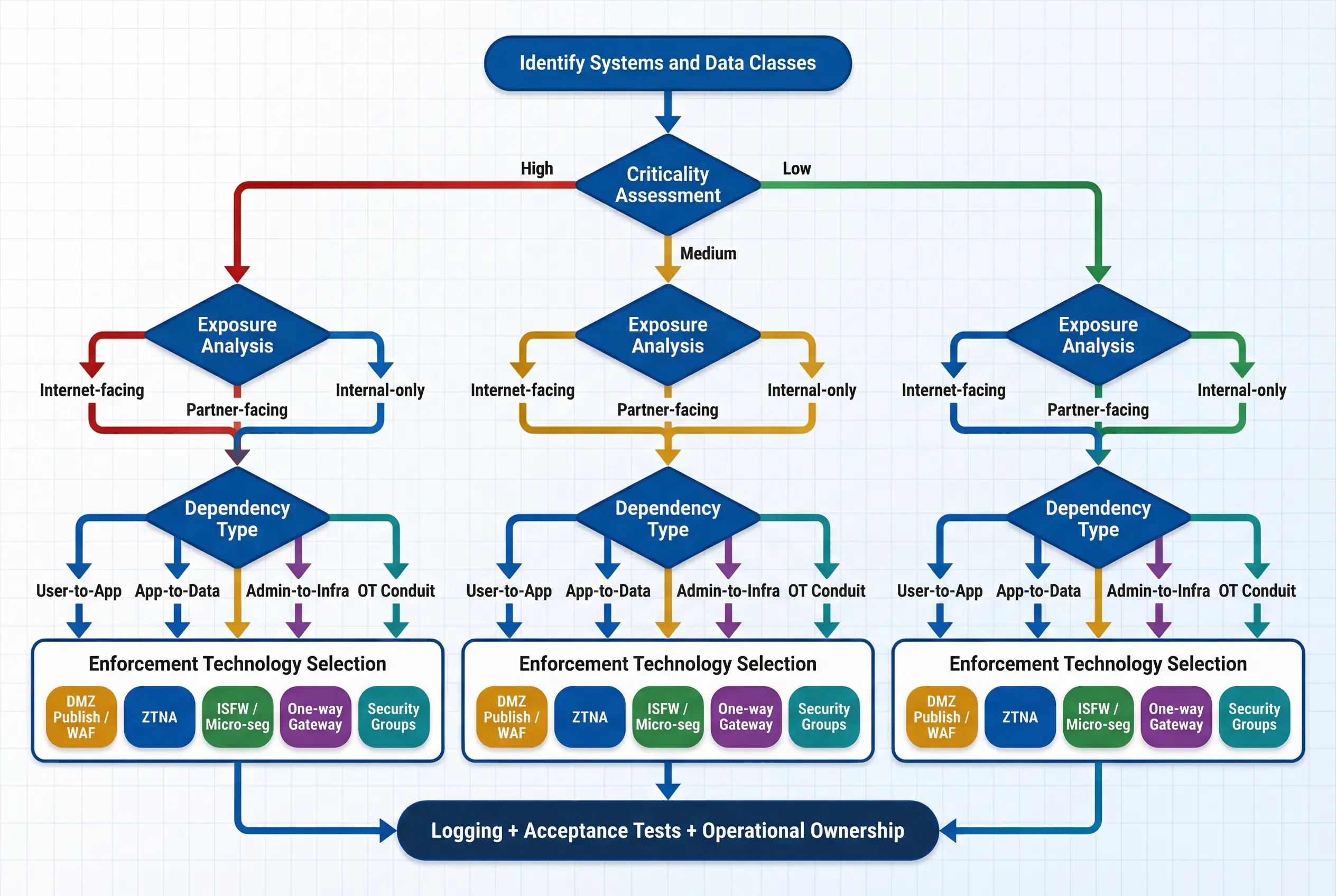
Figure 2.1: Design Decision Tree — Starting from system and data class identification, branching through criticality, exposure, and dependency analysis to enforcement technology selection and operational ownership.
Decision Steps in Detail
- Inventory assets and classify data — categorize as public, internal, confidential, or regulated.
- Identify business domains — Office, Production, O&M, SOC, Dev/Test, OT.
- Create zones by risk/criticality and by traffic patterns — group systems with similar trust levels and flow patterns.
- Define allowed conduits (channels) per flow class — enforce default deny and document every exception.
- Decide enforcement technologies — NGFW/ISFW, proxy/WAF, ZTNA, security groups, host firewall.
- Design audit — log sources, retention, correlation, privileged recordings.
- Plan HA and change/rollback — dual links, HA pairs, versioned configs, rollback procedures.
- Define acceptance tests and metrics — quantitative KPIs for each zone and enforcement point.
2.4 Key Dimensions
A complete segmentation design must be evaluated across multiple engineering dimensions. Optimizing for security alone without considering performance, maintainability, or cost will produce a design that is either abandoned or bypassed in practice. The following dimensions must all be addressed in the design documentation.
| Dimension | Key Considerations | Common Trade-offs | Design Guidance |
|---|---|---|---|
| Performance / UX | Latency overhead of proxy/ZTNA, throughput sizing, session limits | More inspection = more latency; size generously to avoid user complaints | Measure baseline latency; set targets; test under load |
| Stability / Reliability | HA pairs, dual links, failure domains, bypass prevention | HA adds cost; no HA means single point of failure at the boundary | Mandatory HA for all boundary enforcement points; test failover quarterly |
| Maintainability | Rule templates, naming standards, ownership, documentation | Strict naming adds overhead initially; pays off during incidents | Define naming standards before deployment; enforce via linting |
| Compatibility / Extensibility | Multi-vendor interoperability, cloud security groups, APIs | Proprietary features add capability but increase lock-in risk | Standard protocols first; document proprietary dependencies |
| LCC / TCO | Licensing, hardware refresh, staffing, incident cost reduction | Higher upfront cost for proper segmentation vs. high incident remediation cost | Model the cost of a breach vs. the cost of controls |
| Energy / Environment | Device power, cooling, rack layout | More devices = more power; consolidation reduces footprint but increases blast radius | Size power and cooling for peak load + 20% headroom |
| Compliance / Certification | MLPS controls mapping, audit trails, retention | Compliance requirements may mandate specific controls regardless of risk | Map every compliance requirement to a specific control and evidence artifact |