Chapter 10: Quality & Acceptance
Quality benchmarks, acceptance criteria, performance KPIs, compliance validation, and the contrast between poor and best-practice segmentation deployments.
Quality assurance in a segmentation project is not a single event at the end of the implementation — it is a continuous process that begins with design review and continues through the operational life of the system. This chapter defines the quality benchmarks and acceptance criteria that must be met at each stage, provides a visual comparison between poor and best-practice deployments, and establishes the performance KPIs that should be monitored on an ongoing basis to detect quality degradation over time.
10.1 Quality Comparison: Poor vs. Best Practice
The visual comparison below illustrates the most common quality failures in segmentation deployments and contrasts them with the expected best-practice state. The differences are not merely cosmetic — each quality failure on the left side of the comparison represents a specific security risk or operational liability. The quality score reflects the aggregate risk posture of the deployment.
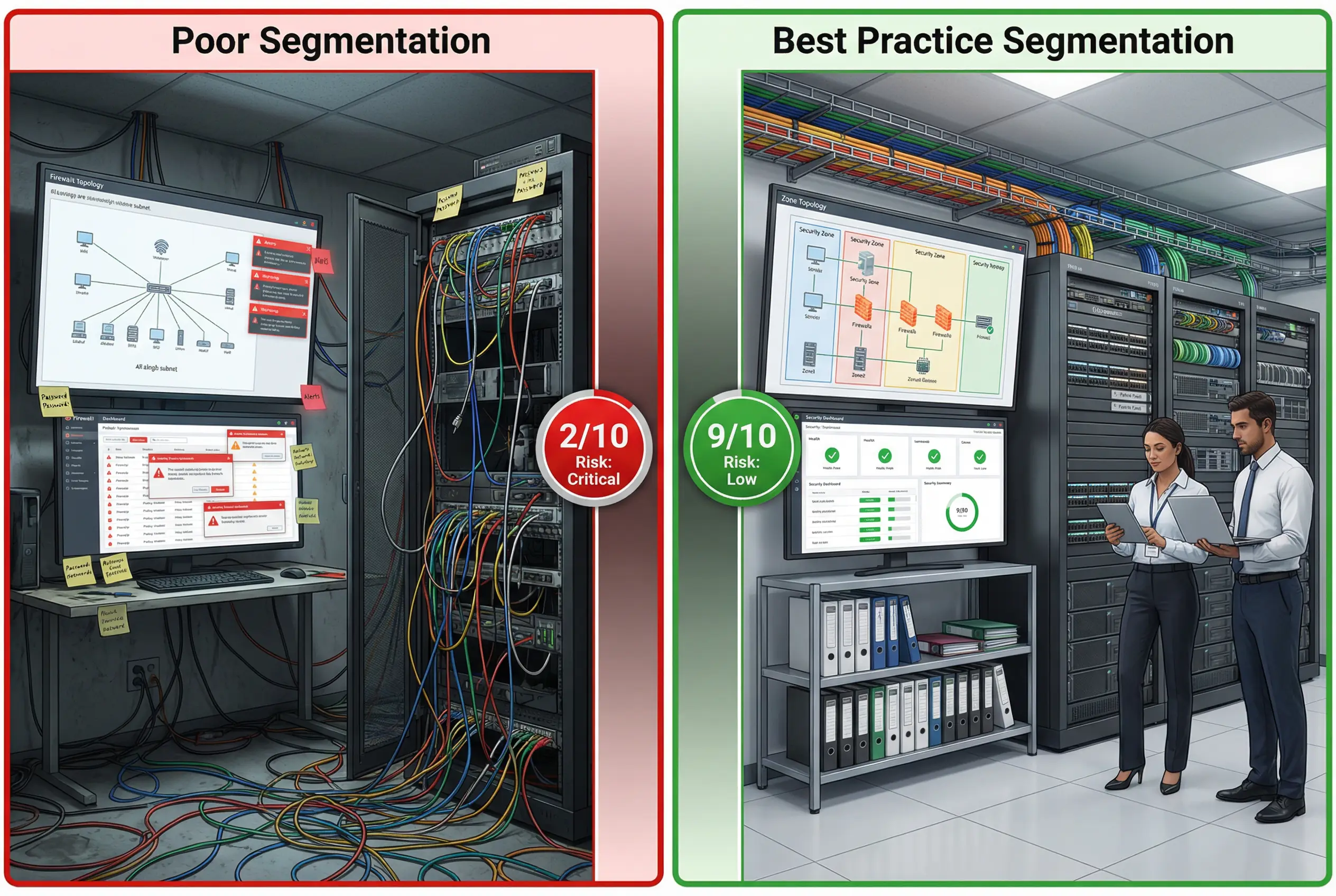
Figure 10.1: Quality Comparison — Left: Poor segmentation showing flat network topology, tangled cables, password sticky notes, and security alerts (Score: 2/10, Risk: Critical). Right: Best practice segmentation showing clean zone topology, organized cable management, professional documentation, and green security dashboard (Score: 9/10, Risk: Low).
Table 10-1: Quality Failure Modes and Remediation
| Quality Failure Mode | Security Risk | Detection Method | Remediation | Priority |
|---|---|---|---|---|
| Flat network (no segmentation) | Any compromised device can reach all others | Network scan — all hosts reachable from any source | Implement zone design from Chapter 2; deploy NGFW/ISFW | Critical |
| Overly permissive firewall rules | Lateral movement paths remain open | Firewall rule review; penetration test | Rule cleanup; implement default-deny; remove "any/any" rules | Critical |
| Direct admin access (no bastion) | Admin credentials exposed to lateral movement | Attempt direct SSH/RDP from Office zone | Deploy bastion/PAM; block direct admin paths | Critical |
| No log forwarding to SIEM | Incidents go undetected; no forensic evidence | Check SIEM for missing log sources | Configure syslog/API forwarding from all devices | High |
| Unlabeled cables | Incorrect cable removal during maintenance | Physical inspection | Label all cables at both ends per standard | Medium |
| No HA for critical appliances | Single point of failure for security boundary | HA status check; failover test | Deploy HA pair; test failover | High |
| Hardcoded/shared credentials | Credential compromise affects all systems | Credential audit; PAM coverage check | Rotate all shared credentials; integrate with PAM | Critical |
| No certificate management | Expired certs cause outages; TLS inspection fails | Certificate expiry scan | Deploy PKI; configure auto-renewal; set expiry alerts | High |
10.2 Acceptance Criteria
The following acceptance criteria define the minimum requirements for a segmentation deployment to be formally accepted. All criteria in the Critical tier must pass with 100% compliance. High-tier criteria must achieve at least 95% compliance, with a documented remediation plan for any gaps. Medium-tier criteria must achieve at least 80% compliance at acceptance, with full compliance within 90 days.
| Acceptance Criterion | Measurement Method | Pass Threshold | Tier |
|---|---|---|---|
| All denied zone-pair flows are blocked | Negative penetration test from each zone | 100% block rate | Critical |
| All permitted zone-pair flows are functional | Positive connectivity test for each permitted flow | 100% success rate | Critical |
| All admin access routes through bastion/PAM | Attempt direct SSH/RDP from Office; verify bastion path works | 100% via bastion | Critical |
| All devices forward logs to SIEM | SIEM log source inventory vs. device inventory | 100% coverage | Critical |
| HA failover within RTO target | Failover test with traffic generator | RTO met; no session loss | High |
| NAC authenticates all managed endpoints | 802.1X test with managed and unmanaged devices | 100% managed auth; guest isolated | High |
| All cables labeled at both ends | Physical inspection of 10% random sample | ≥95% labeled correctly | Medium |
| As-built documentation complete | Documentation review against actual topology | 100% accurate | High |
| All accounts use approved authentication | Account audit; no shared/default credentials | 100% compliant | Critical |
| NTP synchronization within tolerance | Check time drift on all devices | <100ms drift | High |
10.3 Ongoing Performance KPIs
After acceptance, the following KPIs must be tracked on a monthly basis and reviewed at the quarterly security review meeting. A KPI that falls below the target threshold for two consecutive months triggers a mandatory remediation review. KPIs that consistently exceed targets may indicate that the monitoring thresholds need to be recalibrated.
| KPI | Definition | Target | Warning Threshold | Critical Threshold | Review Frequency |
|---|---|---|---|---|---|
| Policy Violation Rate | Blocked inter-zone flows per day / total flows | <0.1% | 0.1–0.5% | >0.5% | Monthly |
| Rule Compliance Rate | Rules with valid ticket ID and review date / total rules | ≥98% | 95–98% | <95% | Quarterly |
| Log Coverage | Devices forwarding logs to SIEM / total devices | 100% | 95–99% | <95% | Monthly |
| HA Availability | Uptime of HA pair / total time | ≥99.9% | 99.5–99.9% | <99.5% | Monthly |
| Certificate Expiry Compliance | Certs renewed before expiry / total certs | 100% | N/A | Any expired cert | Monthly |
| Patch Currency | Devices within 30 days of latest security patch / total | ≥95% | 85–95% | <85% | Monthly |
| Mean Time to Detect (MTTD) | Avg. time from incident start to SIEM alert | <15 min | 15–60 min | >60 min | Monthly |
| Rule Review Completion | Rules reviewed on schedule / total rules due | 100% | 90–99% | <90% | Quarterly |
10.4 Compliance Validation
For organizations subject to regulatory compliance requirements, the segmentation design must be validated against the applicable framework's specific controls. The table below maps the key segmentation controls to the most common compliance frameworks. Organizations subject to multiple frameworks should use the most stringent requirement where frameworks overlap.
| Control Domain | MLPS 2.0 Level 3 | ISO 27001:2022 | PCI DSS v4.0 | NIST CSF 2.0 |
|---|---|---|---|---|
| Network segmentation | Required (8.1.3.1) | A.8.22 | Req. 1.3 | PR.AC-5 |
| Access control | Required (8.1.1.1) | A.8.3 | Req. 7 | PR.AC-1 |
| Privileged access management | Required (8.1.1.3) | A.8.2 | Req. 8.2 | PR.AC-4 |
| Log management | Required (8.1.6.1) | A.8.15 | Req. 10 | DE.CM-1 |
| Vulnerability management | Required (8.1.5.1) | A.8.8 | Req. 11.3 | ID.RA-1 |
| Incident response | Required (8.1.9.1) | A.5.26 | Req. 12.10 | RS.RP-1 |
| Change management | Required (8.1.7.1) | A.8.32 | Req. 6.5 | PR.IP-3 |
| Encryption in transit | Required (8.1.3.4) | A.8.24 | Req. 4.2 | PR.DS-2 |