Network Security Zoning and Segmentation Design Guide
A comprehensive engineering reference for planning, procuring, implementing, and operating network partitioning (zones) and security domains in complex enterprise, government, data center, hybrid cloud, and OT environments.
System Overview
This document is a Network Security Segmentation & Zoning/Domain Design Guide for engineering teams to plan, procure, implement, deliver, and operate network partitioning ("zones") and security domains ("domains") in complex environments. The core purpose is to split the network by business criticality and risk, reduce the attack surface, make lateral movement difficult, and confine faults and compromises to the smallest possible blast radius.
Applicability includes enterprise and government campus networks, data centers, hybrid cloud–network–endpoint architectures, industrial internet and OT environments, and multi-vendor networks with multiple compliance requirements. The guide assumes you will implement explicit cross-zone access paths and controls: "has a reason, has a path, has a control, has an audit." The design baseline is aligned with MLPS 2.0 (China), critical information infrastructure (CII) practices, and common data-security obligations covering segmentation, boundary control, access control, and auditing.
Key inputs include business system inventory, data classification, application dependency flows (ports/protocols), identity sources, compliance requirements, availability targets, and operational constraints such as skills, budget, and change windows. Typical outputs are a zoned/domain architecture, boundary control points, inter-zone access matrix, enforcement designs (NGFW/ZTNA/proxy/security groups), audit design, and acceptance test plan.
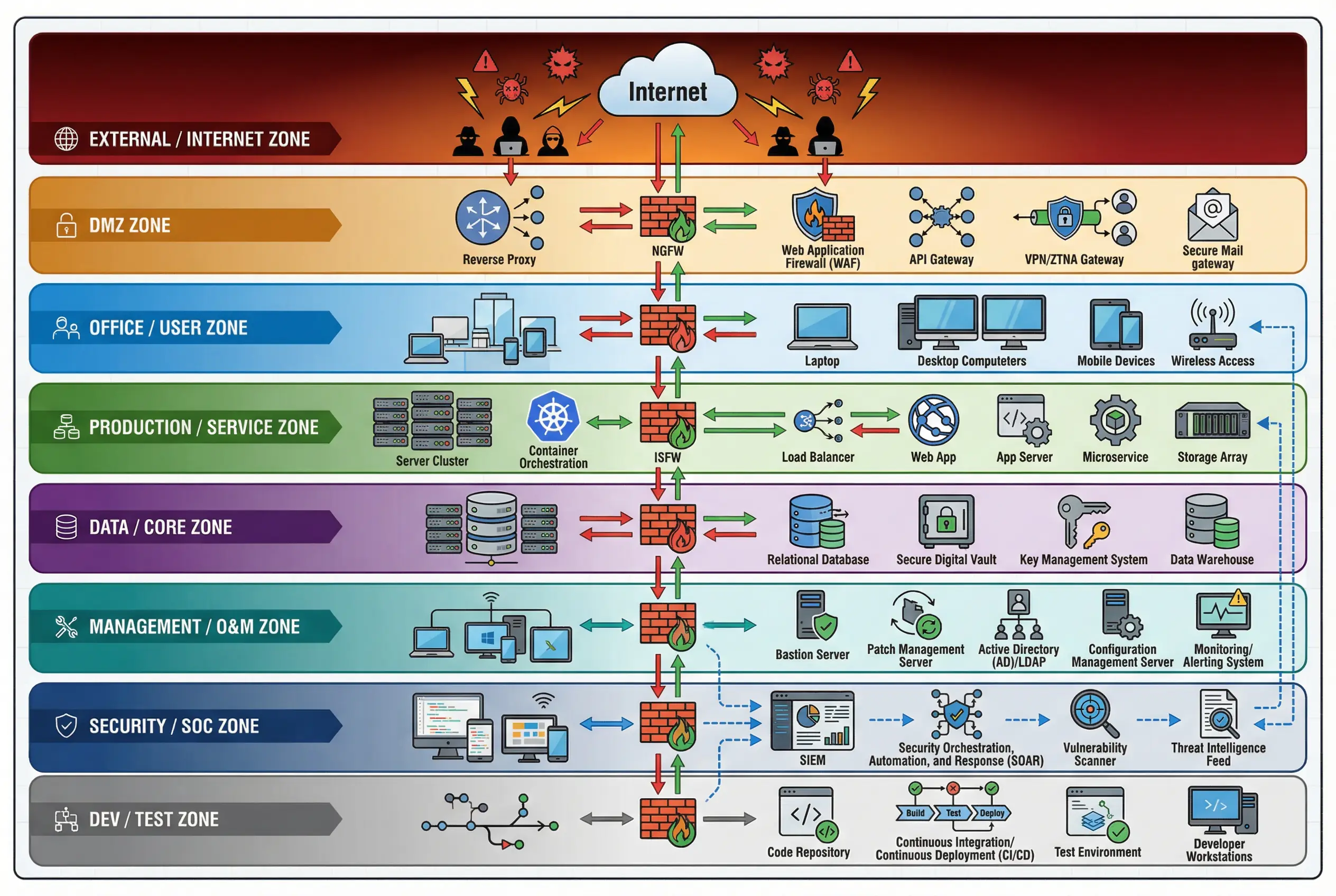
Figure 0.1: Overall Segmentation Reference Architecture — Layered network zones from External/Internet through DMZ, Office, Production, Data, Management, Security/SOC, and Dev/Test, with enforcement points at each boundary.
Layer Responsibilities
The architecture organizes the network into distinct horizontal layers, each with a clearly defined trust level and set of permitted interactions. The table below summarizes the primary responsibility of each zone.
| Zone | Trust Level | Primary Responsibility | Key Controls |
|---|---|---|---|
| External / Internet | Untrusted | Untrusted sources; only published services reachable | Edge NGFW, DDoS mitigation |
| DMZ (Semi-trusted) | Low | Public-facing services, reverse proxy, API gateway, mail relay, VPN/ZTNA entry | WAF, NGFW, ZTNA gateway |
| Office / User | Medium-Low | Endpoints and productivity systems; treated as higher risk | NAC, EDR, ISFW, proxy |
| Production / Service | Medium | Core applications; strict inbound from Office; controlled outbound to Data | ISFW, micro-seg, load balancer |
| Data / Core Data | High | Sensitive storage; minimal inbound; heavy auditing | ISFW, DB audit, DLP, encryption |
| Management / O&M | High | Privileged access plane; bastion, patch/config, identity infra | Bastion, PAM, MFA, OOB network |
| Security / SOC | High (visibility) | SIEM, log pipeline, vulnerability/asset platforms, SOAR | Log collectors, SIEM, SOAR |
| Dev / Test | Low-Medium | Isolated; no direct trust to Production; governed promotion paths | FW deny routing, CI/CD pipeline |
| OT (if present) | Critical | Layered separation with Industrial DMZ and strict conduits | Industrial DMZ, protocol gateways, unidirectional diodes |
Key Functions
The segmentation framework is organized around six core governance functions that collectively ensure isolation, controlled access, visibility, and operational sustainability. Each function maps to specific enforcement components and measurable acceptance criteria.
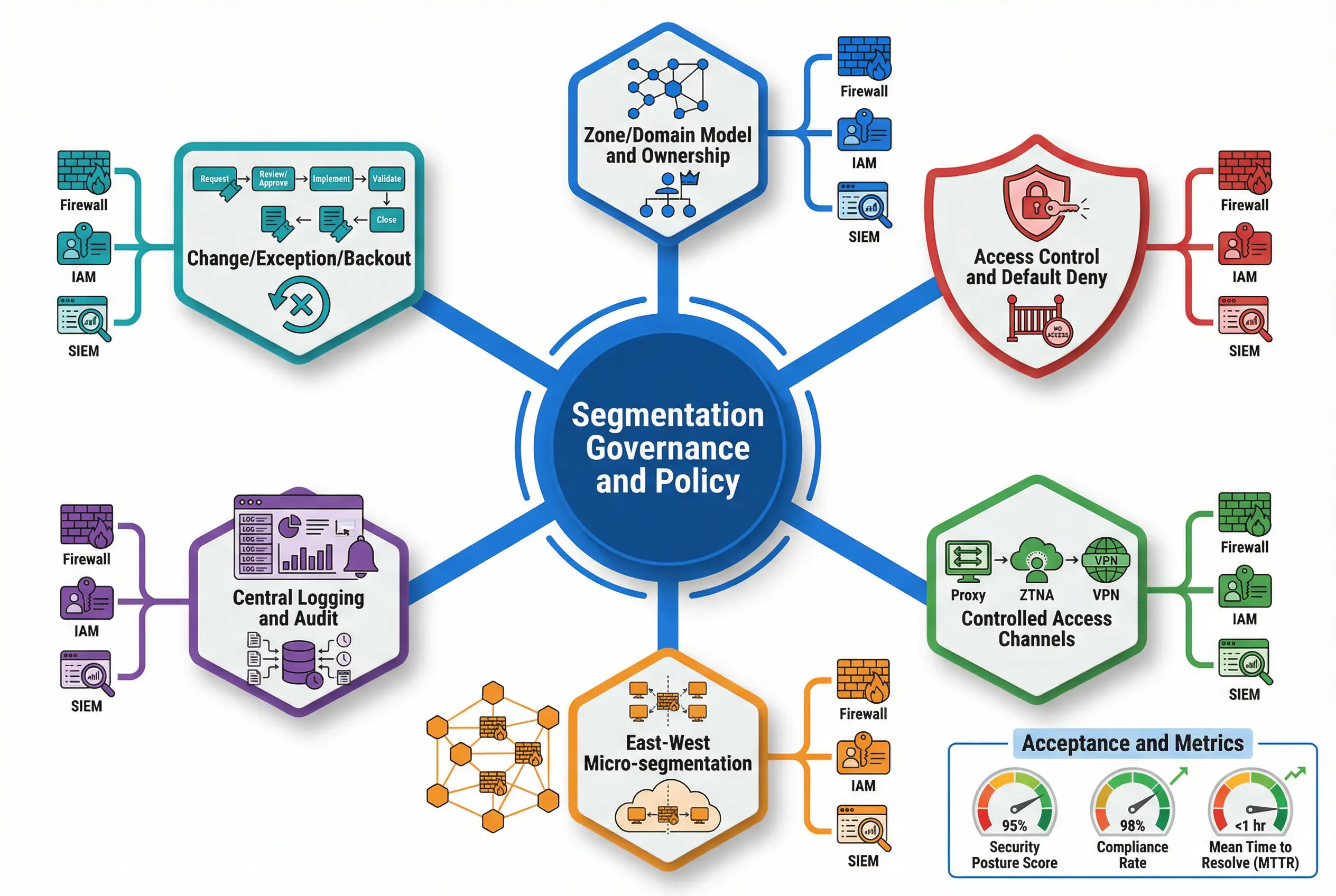
Figure 0.2: Functional Overview Map — Hub-and-spoke model showing six governance functions radiating from the central Segmentation Governance & Policy hub, each connecting to enforcement components and acceptance metrics.
| Function | Core Value | Implementation Approach | Acceptance Focus |
|---|---|---|---|
| Zone/Domain Definition & Asset Classification | Establishes a stable blueprint for isolation and ownership | Asset tagging, data classification, trust level assignment | Every critical asset mapped to a zone; owners defined |
| Inter-Zone Access Control (Least Privilege, Default Deny) | Blocks lateral movement and reduces attack paths | Allowlist rule sets, service-based policies, deny-by-default templates | Rule review passes; unauthorized scans blocked and logged |
| Controlled Cross-Domain Access Channels | Reduces direct network exposure; enforces identity and posture | Publish via reverse proxy/WAF; admin via bastion + MFA; partners via VPN/ZTNA | Access requires identity + MFA; session logs available |
| East–West Micro-segmentation | Shrinks blast radius inside Production and Data zones | Workload labels, policy-as-code, default deny within tiers | Unauthorized east–west blocked; minimal permitted flows documented |
| Audit, Logging, and Traceability | Detects abuse, supports compliance and forensics | Centralized logs, time sync, privileged session recording | Log completeness KPIs met; correlation rules active |
| Operational Governance (Baseline, Exceptions, Change, Rollback) | Segmentation remains maintainable and safe over time | Rule lifecycle workflow, versioning, emergency break-glass | Changes traceable; rollback tested |
Core Value & Typical Deliverables
The primary value of a well-executed segmentation design is a smaller blast radius — when a breach occurs, the attacker's ability to move laterally is constrained by zone boundaries and default-deny policies. This directly reduces the cost and scope of incident response. Secondary benefits include a reduced attack surface through minimized internet exposure, stronger compliance posture through auditable access paths, and operationally manageable security controls that can be maintained by a realistic security team.
Typical deliverables produced by following this guide include: a zoning map with domain ownership model, a rule baseline document, an exception workflow, configuration templates for each enforcement technology, logging and alerting baselines, and operational runbooks covering change management, incident response, and routine maintenance.
Chapter Navigation
This guide is organized into twelve chapters covering system components, design methods, deployment scenarios, architecture patterns, product selection, security risks, support requirements, tools, calculators, quality acceptance, installation, and ongoing operations.